AR Code Object Capture
 AR Splat
 AR GenAI
 AI Code / AI Try-On
 AR Face Filter
 AR Video
 3D Files Upload
 AR Logo
 AR Photo
 AR Portal
 AR Text
 AR Data API
 Education & Schools
 E-commerce Brands & Online Stores
 Fitness & Sports Clubs
 Manufacturing, Training & Safety
 Marketing Teams & Agencies
 Museums & Exhibitions
 Real Estate & Property Marketing
 Restaurants & Cafés
 Retail Stores & Showrooms
 Smart Cities & Urban Development
 Books, Guides & Magazines
 Business Cards
 Event Posters & Banners
 Event Tickets & Access
 Flyers & Brochures
 Labels & Product Information
 Machinery & Equipment
 Product Packaging
 Websites & Online Stores
Augmented Reality Fitness Training: AR QR Codes for Gyms
AR Code Tech | 22/11/2026 |
Augmented reality fitness training is gaining attention as gyms, sports clubs, and instructors look for more accessible ways to explain exercises and support their members. New research published on November 14, 2026, provides fresh insights into how exercise guidance can be designed around users' needs.
The study, published in Scientific Reports, examined an augmented reality training experience for Baduanjin, a traditional Chinese exercise practice involving a sequence of controlled movements. Researchers evaluated which features users considered important and developed an interactive prototype to explore those requirements.
The findings offer useful design lessons for fitness professionals. They also highlight opportunities for app-free augmented reality experiences, including exercise demonstrations, training information, and instructional content accessible through AR QR Codes.
What the November 2026 AR Fitness Research Found
The study, User-centered augmented reality design of BaDuanjin exercise, was published on November 14, 2026, in Scientific Reports.
Researchers combined expert interviews, focus group discussions, and structured analysis of user requirements to understand how augmented reality might support exercise instruction.
Instead of focusing only on sophisticated technology, the researchers evaluated what people actually needed from an exercise experience.
The design process considered different categories of user requirements, including essential functions, features whose quality affects satisfaction, attractive enhancements, and features considered relatively unimportant.
The resulting experimental prototype included several capabilities:
- Real-time posture feedback: Interactive guidance designed to help users understand their movements.
- Customizable training environments: Different virtual settings for the exercise experience.
- Personalized training records: Information designed to help users follow their training activities.
- Culturally relevant interactions: Digital presentation designed around the traditional exercise practice.
The prototype was evaluated using established usability and user-experience questionnaires. Preliminary results indicated acceptable usability and positive participant experiences.
However, the study did not demonstrate that the system improved physical performance, corrected movements more accurately than a trainer, or produced measurable health benefits. Its main contribution is a structured approach to designing exercise experiences around user expectations.
Why Augmented Reality Is Relevant to Modern Fitness Centers
For gym operators, one practical challenge is helping members access clear exercise instructions when trainers are not immediately available.
Printed equipment labels often contain only basic diagrams or short instructions. Standard videos provide more detail but may require members to search through a website, training library, or dedicated application.
Augmented reality provides another option: connecting physical equipment and training spaces with relevant digital content.
For example, an AR QR Code placed beside a gym machine can provide access to an instructor's demonstration when a member scans it using a compatible smartphone.
This approach offers several practical benefits:
- Immediate access: Members can find instructions at the location where they need them.
- Visual explanations: Video demonstrations can communicate movement sequences more clearly than a small printed diagram.
- Flexible onboarding: New members can review basic equipment instructions alongside staff-led introductions.
- Accessible updates: Facilities can revise digital information without replacing every printed sign.
These are potential operational benefits, not outcomes measured in the November research. Their value should be assessed through real member feedback and appropriate safety reviews.
AR QR Codes Make Exercise Demonstrations Easier to Access
One straightforward application of augmented reality fitness training is the use of QR-triggered instructional videos.
AR Code provides an AR Video solution that allows organizations to publish supported video content as augmented reality experiences accessible through scannable AR QR Codes.
A gym could prepare short instructor-led demonstrations and make them accessible from relevant exercise stations, training posters, or introductory materials.
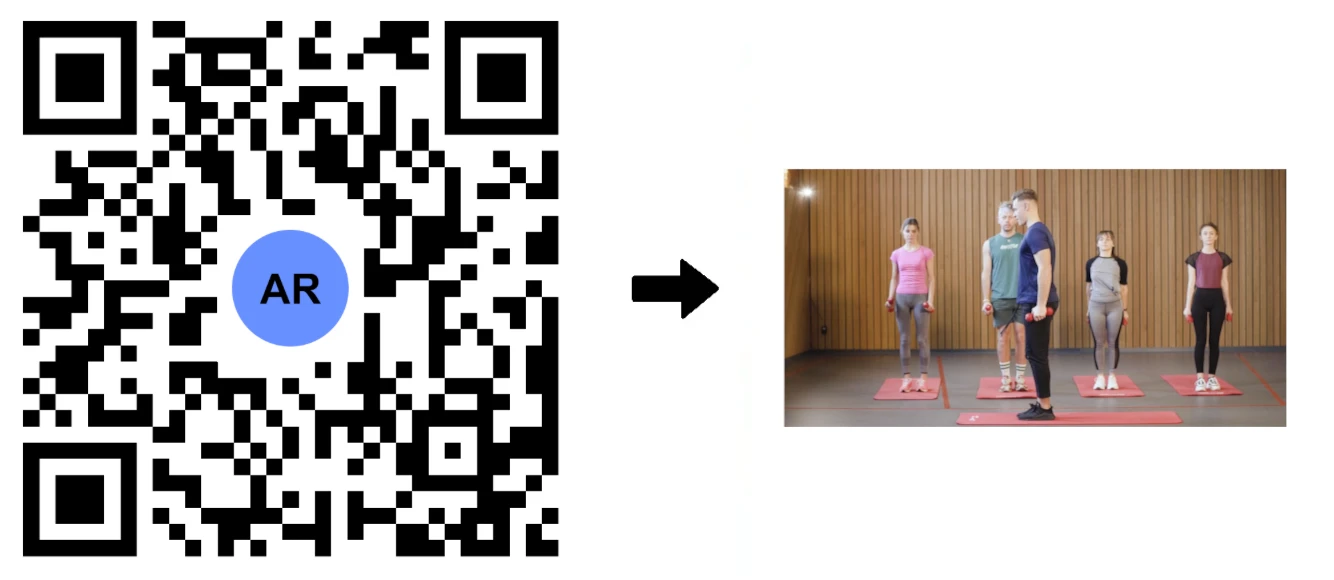
The illustration demonstrates AR Code's QR-triggered video format. Fitness centers can apply the same publishing approach to their own approved workout demonstrations.
For example, a strength-training area could provide short explanations of equipment setup, intended movement, and general safety considerations. A group-exercise studio could share introductions to upcoming classes or basic movement sequences.
Video guidance is particularly useful for repeating information consistently. It should remain supplementary to qualified instruction, especially when exercises involve unfamiliar equipment, challenging movements, or individual physical limitations.
Practical AR Fitness Applications for Gyms and Sports Clubs
The research suggests that useful AR training experiences should be designed around participants' expectations rather than technology alone. Fitness operators can apply this principle by prioritizing clear, relevant content.
Several applications fit existing fitness-center operations:
- Equipment introductions: Place AR QR Codes near supported machines to share instructor-approved demonstrations and setup explanations.
- New-member orientation: Connect membership materials with short facility walkthroughs, equipment information, and general training guidance.
- Group fitness previews: Give prospective participants access to class introductions and examples of movements they may encounter.
- Personal training support: Provide clients with recorded explanations of exercises already reviewed with their trainer.
- Sports club communication: Connect training areas and club signage with instructional content, schedules, or event information.
Each implementation should have a clear purpose. A simple exercise demonstration can be more useful than a complex interactive experience if members can understand it quickly and return to their activities.
How AR Code Supports Fitness Training and Member Engagement
AR Code offers a dedicated augmented reality solution for gyms and sports clubs, including the ability to distribute exercise videos and instructional content through physical and digital touchpoints.
With AR Code, a facility can create QR-linked experiences, place them in appropriate locations, and manage published materials through its SaaS dashboard.
The platform also provides scan analytics that can help operators understand which QR-linked content attracts attention. Scan activity does not, by itself, establish that members learned a movement correctly or improved their fitness.
For exercise training, the most relevant documented functionality is AR Video. This supports the presentation of recorded instructions without requiring the gym to develop a dedicated mobile application.
It is important to distinguish this from the experimental system described in the November study. AR Code does not document automatic real-time posture correction, motion assessment, or personalized biometric training records as standard AR Video features.
Facilities interested in those advanced functions would need separately verified technology. For many gym communication tasks, however, accessible video guidance may provide a more manageable starting point.
Five Steps to Launch an AR Workout Demonstration Pilot
Fitness centers can test augmented reality without immediately transforming their entire training experience.
- 1. Select a limited number of exercises. Begin with familiar equipment or introductory movements that members frequently ask about.
- 2. Record professional demonstrations. Use qualified instructors to prepare concise videos with clear explanations and appropriate safety guidance.
- 3. Publish the AR experiences. Upload suitable content through AR Code and generate AR QR Codes for the selected exercises.
- 4. Place codes where they are useful. Position them on approved equipment signage or nearby displays without obstructing safety labels or machinery controls.
- 5. Evaluate member feedback. Test scanning reliability, clarity of instructions, accessibility, and whether members find the demonstrations useful.
A small pilot helps operators identify practical obstacles before expanding. Poor lighting, unreliable connectivity, unclear instructions, or inconvenient code placement can reduce the usefulness of an otherwise well-designed experience.
Gym teams should also establish a process for reviewing content whenever equipment, training procedures, or safety recommendations change.
What the Research Means for the Future of AR Fitness Training
The November 2026 study reinforces a useful principle: augmented reality exercise systems should respond to real user needs, not simply add digital effects to physical activity.
Its preliminary usability findings support further research into exercise-interface design. They do not justify claims that augmented reality automatically increases motivation, improves athletic performance, or reduces injury rates.
For fitness businesses, the immediate opportunity is more practical. Clear instructional content, easy access, and thoughtful placement can make digital training materials more convenient for members.
AR QR Codes offer a way to explore these possibilities without building a complete fitness application. Gyms and sports clubs can start with a small collection of instructor-approved demonstrations, test how members use them, and expand when the results justify further investment.
Explore AR Code's fitness applications to see how scannable augmented reality content could complement training, onboarding, and communication across your facility.
Frequently Asked Questions
What is augmented reality fitness training?
Augmented reality fitness training uses digital visual content within an augmented reality experience to support physical exercise instruction. Depending on the system, it may include demonstrations, interactive guidance, or specialized motion feedback. AR QR Codes can provide access to supported exercise videos and instructional experiences on compatible smartphones.
What did the November 2026 AR fitness study discover?
The Scientific Reports study examined user requirements for an augmented reality Baduanjin exercise application. Researchers developed a prototype featuring posture feedback, customizable environments, and training records. Preliminary evaluations indicated acceptable usability and positive user experience, but the study did not establish improvements in exercise performance or health outcomes.
How can gyms use AR QR Codes for workout demonstrations?
Gyms can place AR QR Codes on appropriate equipment signage, training posters, or onboarding materials. Members scan the code using a compatible smartphone to access instructor-approved demonstrations or other supported content. AR Code's AR Video solution provides tools for publishing and managing these experiences without requiring a dedicated mobile application.
Can AR Code automatically correct exercise posture?
AR Code's documented fitness applications include AR Video demonstrations, QR-linked information, and member engagement features. Automatic real-time exercise posture correction is not a documented standard AR Video capability. Gyms should use qualified professional instruction for individual movement assessment and verify specialized motion-tracking systems separately.
AR Code Tech - Latest Blog Posts
Augmented Reality Training in Manufacturing: New 2026 Research and Practical Factory Use Cases

Technicians can access equipment instructions directly by scanning a QR code on the machine. Instead of searching for printed manuals or relying on experienced operators, they can instantly view interactive 3D models and short visual guides that provide clear, step-by-step instructions for each task. On October 27,...
AR Code and NFCOP: The Future of NFC, QR Codes, AR & AI

The physical world is becoming a gateway to digital experiences. Augmented Reality (AR), Artificial Intelligence (AI), Near Field Communication (NFC), and QR Code technology now make it possible to connect products, printed materials, and physical locations to interactive content that people can access directly from...
Best 3D Scanning Solutions for Augmented Reality: AR Code Object Capture, AR GenAI, AR Splat & AI Code

Creating an effective augmented reality experience starts with choosing the right way to digitize an object or generate interactive content. Depending on the object you want to capture, its materials, the level of realism required, and the type of experience you want visitors to have, AR Code provides several...
Instantly Download .MP4 Demo Videos of Your AR 3D Models

In today's digital-first business environment, presenting 3D content efficiently is critical for standing out. AR Code delivers a powerful capability that enables users to download demo videos of their 3D models directly from the platform, significantly streamlining content creation for marketing, client...
AR GenAI: Turn a Single Photo into an AR-Ready 3D Model

Drive business growth with AR GenAI image to 3D technology on the AR Code SaaS platform. AR Code enables you to convert product photos into interactive, immersive 3D models, instantly accessible in Augmented Reality. No specialized apps or 3D modeling experience is necessary—simply upload an image and share...
AR Splat: A New 3D Scanning-to-Augmented Reality Solution Based on Gaussian Splatting

AR Splat by AR Code enables businesses to seamlessly create and deploy immersive 3D web augmented reality experiences. Upload a simple walk-around video and generate photorealistic 3D scenes with advanced Gaussian Splatting technology. Share your AR content instantly using AR QR Codes, providing fast,...
AI Code’s Image Generation Redefines Product Visualization Through a QR Code Scan

AR Code is revolutionizing Augmented Reality and Artificial Intelligence for businesses by enabling instant AI-powered product visualizations through a single QR code scan. Boost customer engagement and increase interaction by leveraging AI Code, ar genai, and other robust AR Code SaaS solutions for immersive...
AR Code Object Capture Now Works on All iPhones and iPads No LiDAR Required
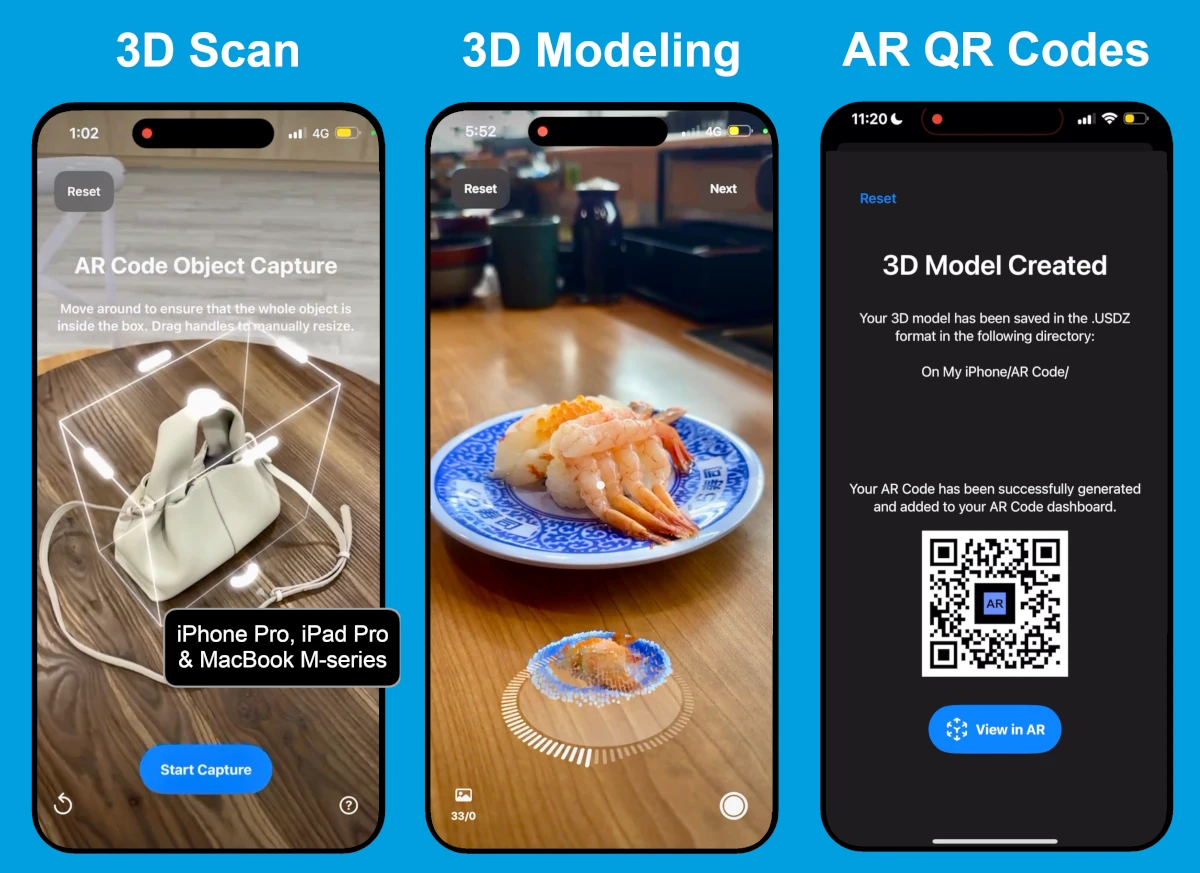
Accelerate business transformation with advanced augmented reality using the ar code object capture solution. Effortlessly capture, create, and share 3D models and AR QR Codes on any iPhone or iPad. Eliminate dependence on LiDAR and streamline your workflows with engaging AR marketing, lifelike product demonstrations,...
3D Scanning from Video Now Available on the AR Code Web Interface
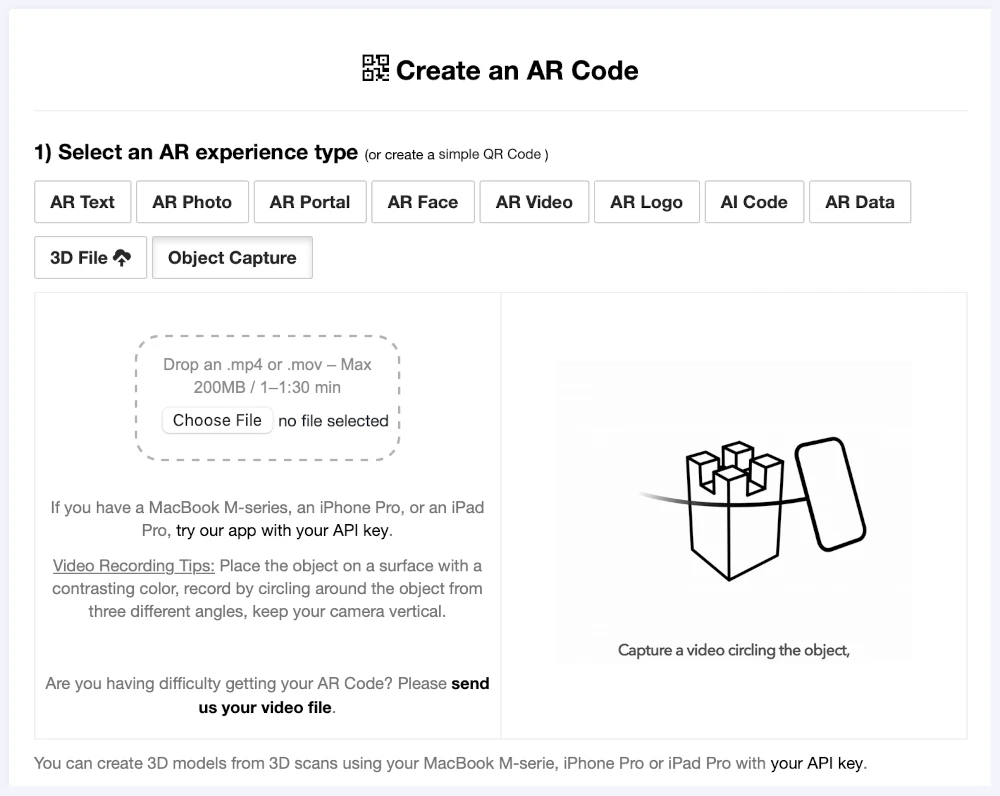
Accelerate business growth with Object Capture, a browser-based SaaS transforming simple video capture into immersive augmented reality. Boost brand engagement and streamline workflows with a no-code solution tailored for business. Simplify AR marketing for your business. Upload a short video through your...
Guide to 3D Scanning with Our "AR Code Object Capture" Solution
Drive your business’s digital transformation with ar code object capture, the leading SaaS platform for advanced 3D scanning and interactive augmented reality. Empower your organization to deliver accurate 3D models for marketing, e-commerce, manufacturing, and product demonstrations. Accelerate engagement and...
164,326 AR experiences
75,044 Scans per day
149,690 Creators